

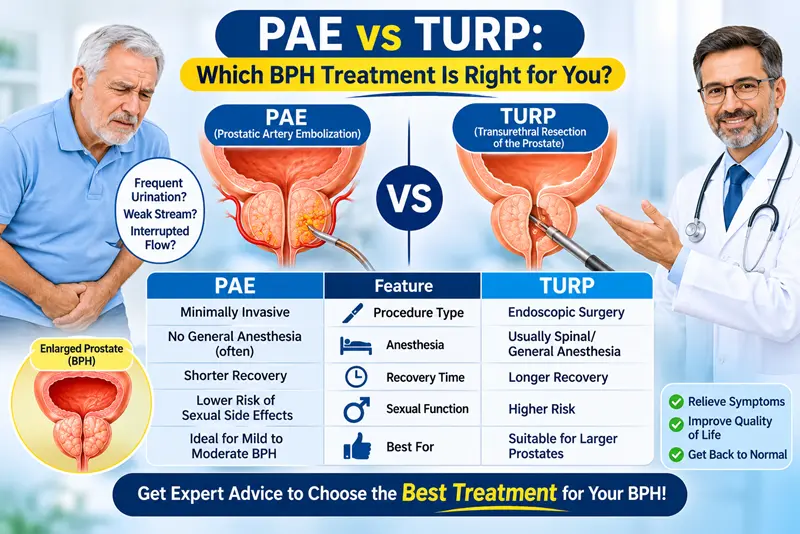
In the PAE vs TURP comparison, TURP (transurethral resection of the prostate) is a surgery with more long-term evidence and a lower chance of needing another treatment, while PAE (prostate artery embolization) avoids surgery, uses local anaesthetic and more often preserves ejaculation. Neither is better for everyone. The right choice depends on your symptoms, prostate size, other health problems and what matters most to you.
An enlarged prostate (benign prostatic hyperplasia, or BPH) can make passing urine slow, frequent and disturbed at night. When tablets no longer help enough, the next question is what else is available. This guide compares prostate artery embolization vs TURP in plain language, including where the evidence is strong and where it is limited.
What Are PAE and TURP?
TURP is a surgical operation. A surgeon passes a thin instrument through the urethra and trims away the part of the prostate that is blocking urine flow. It is usually done under spinal or general anaesthetic and is the long-standing standard operation for BPH.
PAE is a procedure performed by an interventional radiologist. A catheter is guided from the wrist or groin to the arteries that feed the prostate, and tiny particles are released to reduce the blood supply. Over weeks to months the prostate can shrink. Nothing is cut and nothing is passed through the urethra. You can read more about our approach to prostate artery embolization treatment in Delhi.
PAE vs TURP at a Glance
| Feature | PAE | TURP |
| Type | Image-guided, through an artery | Surgery, through the urethra |
| Anaesthesia | Usually local, with or without sedation | Usually spinal or general |
| Effect on prostate | Reduces blood supply; gland shrinks gradually | Removes prostate tissue directly |
| Catheter afterwards | Not always required; depends on the case | Usually needed for a short time |
| Hospital stay | Often day-care or short stay | Usually a few days |
| Ejaculation | Often preserved | Retrograde ejaculation is common |
| Chance of retreatment | Higher in studies | Lower |
| Strength of evidence | Growing; certainty rated low in reviews | Extensive, long track record |
| Best known for | Option for men avoiding surgery | Most established operation |
What Does the Evidence Say?
A Cochrane review that compared PAE with TURP found that the certainty of evidence was mostly low or very low. It reported that PAE likely leads to more retreatment, may cause fewer ejaculation problems, and may be similar for erection problems. Several meta-analyses of randomised trials point the same way: symptom improvement with PAE is often similar to TURP, but TURP tends to give a larger improvement in urine flow and a greater reduction in prostate size, and PAE tends to shorten hospital stay.
Longer-term data show how benefits can change. In a Danish nationwide study of 336 men, about 18% needed further surgery and about 30% had restarted medicines within five years, although many men remained improved. Guideline bodies have moved cautiously. The American Urological Association’s 2023 update says PAE may be offered but grades the supporting evidence as limited, and UK guidance (NICE) judged the evidence adequate if standard safeguards are in place.
TURP Side Effects and PAE Risks Compared
TURP side effects can include retrograde ejaculation (semen passing back into the bladder), bleeding, temporary difficulty passing urine, urinary infection, narrowing of the urethra (stricture) and, less often, leaking of urine. A rare condition called TURP syndrome can occur from fluid absorption during the operation.
PAE risks include post-embolization syndrome (pelvic discomfort, burning urination, low fever, nausea), bruising at the access site, blood in urine or semen, urinary infection and temporary retention. Rarely, particles reach nearby organs such as the bladder, rectum or penis and cause damage. This is why experience and careful imaging matter. In the Danish study, post-embolization syndrome affected about 39% of men and serious adverse events about 7.7%.
No treatment is risk-free. A good consultation compares the risks that matter most to you, such as sexual function, anaesthesia risk or the chance of a second procedure.
Recovery: Which Is Quicker?
PAE generally means less time in hospital and no surgical wound, and many men go home the same day or after a short stay. TURP usually needs a catheter and a stay of a few days, with a gradual return to normal activity. With PAE, improvement builds over weeks to months, so the benefit may appear later than after surgery. Recovery depends on your general health and your doctor’s advice.
Pros and Cons of PAE and TURP
| Pros | Cons | |
| PAE | No surgery or incision; usually local anaesthetic; ejaculation often preserved; shorter stay | More likely to need retreatment; benefit may fade; less long-term evidence; needs specialised expertise; smaller improvement in flow in some studies |
| TURP | Well-established; strong long-term data; usually larger improvement in flow and prostate size; lower retreatment | Anaesthesia needed; catheter and longer stay; ejaculation problems common; risks of bleeding, stricture, rarely incontinence |
Who May Prefer PAE, and Who May Prefer TURP?
PAE may be worth discussing if you have bothersome BPH symptoms despite medicines, you are not a good candidate for surgery or anaesthesia, you want to avoid ejaculation changes, and you accept a higher chance of retreatment.
TURP or another surgery may suit you better if you want the most established and durable result, your symptoms are severe or you have had urinary retention, or your prostate is very large, where other surgical techniques may also be considered. PAE is usually not suitable if prostate cancer is suspected and not yet assessed, if your symptoms come from another cause, or if your arteries make safe catheter access difficult.
Your doctor can also discuss other BPH treatment options, including medicines, laser surgery such as HoLEP and other minimally invasive procedures. Ask whether your prostate has been checked for cancer before any procedure is chosen.
Questions to Ask Your Doctor
- Are my symptoms definitely from BPH, and has cancer been considered?
- Which options suit my prostate size and health?
- How often is each procedure repeated, and what happens if it fails?
- What are the effects on ejaculation and erections?
- How many of these procedures does your team perform each year?
- What will each option cost in total, including tests and follow-up?
When to See a Doctor
See a doctor if you have a weak stream, frequent or night-time urination, or a feeling that you cannot empty your bladder. Get urgent help if you cannot pass urine, see blood in your urine, or develop fever with urinary symptoms.
If you are weighing PAE against surgery, bring your PSA report, urine flow test, prostate ultrasound and medicine list to a consultation. Our team can explain whether prostate artery embolization treatment in Delhi is suitable for you, or whether another option is a better fit. See our full page on prostate artery embolization treatment in Delhi, and read about what affects the cost of prostate artery embolization in Delhi.
Call +91 99584 74870 or WhatsApp +91 99584 74870. Department of Interventional Radiology, Sir Ganga Ram Hospital, Old Rajendra Nagar, Delhi – 110060.
Medical disclaimer: This article is for general information and does not replace medical advice, diagnosis or treatment. Suitability and results vary from person to person. Always consult a qualified doctor about urinary symptoms.
FAQ Section
What is the difference between PAE and TURP?
PAE blocks part of the prostate’s blood supply through a catheter in an artery, so the gland shrinks gradually. TURP is an operation that removes prostate tissue through the urethra. PAE avoids surgery, while TURP has more long-term evidence.
Which is more effective, PAE or TURP?
TURP generally gives a larger improvement in urine flow and prostate size, and a lower chance of retreatment. PAE can give similar symptom relief for many men, but evidence is less extensive. The better choice depends on your situation.
Which has fewer side effects?
They have different side effects. TURP more often causes ejaculation problems, while PAE can cause post-embolization symptoms and, rarely, damage to nearby organs. Compare the risks that matter most to you with your doctor.
Does TURP cause problems with ejaculation?
Yes, retrograde ejaculation, where semen passes into the bladder, is a common effect of TURP. Studies suggest it is less frequent after PAE, though no outcome can be promised.
Is PAE a permanent solution?
Not always. Benefit can fade over time, and in one Danish study about 18% needed further surgery and about 30% restarted medicines within five years. Some men remain well for years, but retreatment is more likely than after TURP.
Which has the faster recovery?
PAE usually means a shorter hospital stay and no surgical wound, while TURP usually needs a catheter and a few days in hospital. PAE symptom relief may build more slowly, over weeks to months.
Can PAE be done if I have a large prostate?
PAE has been studied in men with moderately large prostates, but suitability is decided individually after imaging and tests. Very large prostates may be better treated with other surgical methods.
Are there other options besides PAE and TURP?
Yes. Options include medicines, laser surgery such as HoLEP and other minimally invasive procedures. A urologist and an interventional radiologist can help you compare them for your case.
Can I have surgery after PAE?
Yes. Some men have needed surgery after PAE, so having PAE does not close the door on other treatments. Tell your surgeon about any earlier embolization.
When should I see a doctor about urinary symptoms?
See a doctor if you have a weak stream, frequent or night-time urination, or a feeling that your bladder is not empty. Seek urgent help if you cannot pass urine, see blood in the urine, or have fever with urinary symptoms.
References
- Cochrane review, prostatic arterial embolization for LUTS in men with BPH (CD012867): https://www.cochrane.org/CD012867 (PAE vs TURP: low or very low certainty; likely more retreatment; erectile function may be similar; may reduce ejaculatory disorders).
- Xu et al., updated meta-analysis of PAE vs TURP, Frontiers in Surgery 2021: https://www.frontiersin.org/journals/surgery/articles/10.3389/fsurg.2021.779571/full (five RCTs, 402 patients; IPSS not significantly different; greater prostate volume reduction and Qmax rise with TURP).
- Updated meta-analysis in Urology guidelines portal summary: https://uroluts.uroweb.org/?p=13800 (nine studies, 860 patients; TURP still considered the gold standard). Check against the original paper.
- Wang et al., PAE for LUTS related to BPH, systematic review and meta-analysis, World J Clin Cases 2022: https://wjgnet.com/2307-8960/articlehighlights/v10/i32/11812.htm (similar IPSS; lower retrograde ejaculation and shorter hospital stay with PAE).
- Jiang and Qian, TURP vs PAE meta-analysis, BMC Urology 2019: https://www.ncbi.nlm.nih.gov/pmc/articles/PMC6350315/ (TURP complications).
- Danish nationwide cohort, long-term outcomes of PAE: https://www.urotoday.com/recent-abstracts/pelvic-health-reconstruction/lower-urinary-tract-symptoms/162664-long-term-outcomes-of-prostatic-artery-embolisation-a-nationwide-prospective-cohort-study.html and summary https://www.urotoday.com/video-lectures/lower-urinary-tract-conditions/video/5322-five-year-outcomes-and-retreatment-rates-following-prostate-artery-embolization-diana-lopategui.html (serious events 7.7%; post-embolization syndrome 39%; retreatment 18% surgical, 30% medical at five years). The video summary is secondary: check against the paper.
- Urologist’s perspective on PAE, Endovascular Today 2024: https://assets.bmctoday.net/evtoday/pdfs/et0224_F6_PAEUrologist.pdf (2023 AUA update; TURP complication rates).
- NICE interventional procedures guidance IPG611: https://www.nice.org.uk/guidance/ipg611/resources/prostate-artery-embolisation-for-lower-urinary-tract-symptoms-caused-by-benign-prostatic-hyperplasia-pdf-1899873917137861